
Chamberlain Garage Door Opener Repair in Massachusetts
Same-day Chamberlain opener diagnostics by Desco Garage Door Repair in Stoughton. We serve 247 Massachusetts cities, hold 94 reviews at 4.9 stars, and focus on durable repairs before replacement.
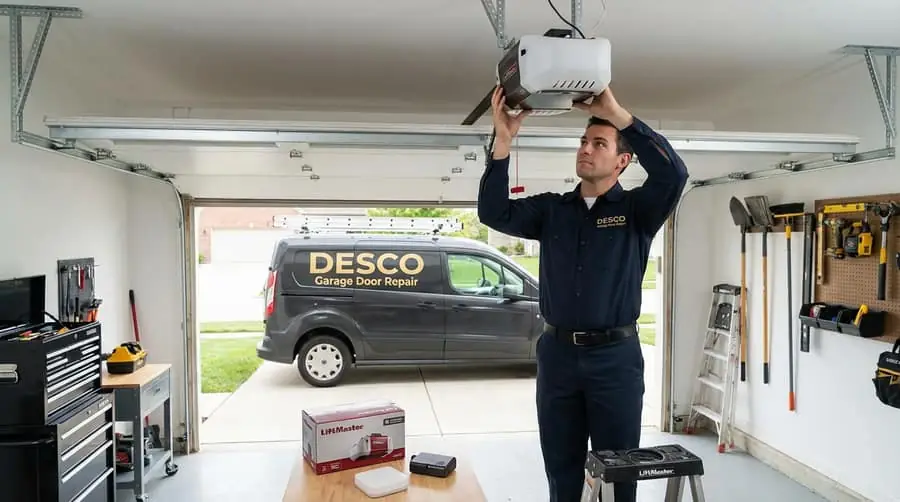
Chamberlain opener repair by a full-system team
A Chamberlain opener rarely fails in isolation. Homeowners often call because the motor hums, the door reverses, remotes stop responding, or MyQ suddenly reports the opener as offline. Those symptoms can come from the opener itself, but they can also come from a heavy unbalanced door, worn springs, track friction, or sensor wiring faults. At Desco Garage Door Repair, we diagnose the opener and the door as one mechanical-electrical system, which is why our fixes tend to hold up better over time than simple part swapping.
Our company is based in Stoughton, MA and serves 247 cities across Massachusetts. We keep diagnostics practical and transparent: if a Chamberlain unit can be repaired safely and cost-effectively, we repair it. If replacement is smarter due to age, repeated breakdowns, or unavailable boards, we explain that clearly with model-appropriate options. Homeowners choose us because the recommendation is based on reliability and safety, not pressure.
Local expertise, statewide reach
Stoughton-based service with dispatch across Massachusetts, including greater Boston, MetroWest, North Shore, South Shore, and central cities.
Trusted by homeowners
94 reviews averaging 4.9 stars from customers who needed quick diagnosis and clear communication.
Brand-specific diagnostics
Chamberlain model behavior, MyQ pairing paths, rail-drive differences, and board generation quirks are all part of our workflow.
Repair-first approach
We restore sensors, gears, capacitors, travel limits, and drive systems when that option is durable and economical.
Chamberlain models and platforms we service
B-series and C-series chain-drive openers
Chain-drive Chamberlain units are known for strength and straightforward mechanical layout. Typical service calls include chain slack noise, rail vibration, stripped drive gear assemblies, and intermittent starts in colder garages. Many chain-drive complaints are worsened by poor door balance, where the opener is forced to do lifting work that springs should handle. We verify chain condition, sprocket wear, carriage travel, and force calibration after any repair.
Belt-drive models with quiet operation
Belt-drive Chamberlain models are common in attached garages where low noise matters. Over time, homeowners may report slipping, uneven movement, delayed starts, or rail chatter. These issues can involve belt tension, carriage wear, motor start components, or cracked mounts that transfer vibration into framing. We inspect the complete drive path and tune travel limits so the opener closes fully without hard floor impact or repeated reversal.
Smart Chamberlain units with built-in MyQ
Many modern Chamberlain openers include integrated MyQ control. In these models, support calls often combine physical and digital symptoms. The door may operate from the wall station but not the app, or notifications may fail while basic open/close still works. We separate hardware operation from account and network layers to avoid unnecessary board replacement when the core motor system is healthy.
MyQ troubleshooting: where app problems really start
MyQ issues are among the most common Chamberlain complaints in Massachusetts homes. Garage placement, metal track structures, and router distance can cause unstable signal quality that appears random to the homeowner. A successful MyQ repair path checks firmware state, opener registration status, router behavior, and account permissions in the right order. If the sequence is wrong, the system may reconnect temporarily and fail again days later.
| MyQ Symptom | Likely Root Cause | What We Verify | Typical Outcome |
|---|---|---|---|
| Opener works by wall button but not app | Account binding or stale device state | Device registration, account link, firmware handshake | Re-provisioned app control with stable pairing |
| Frequent offline alerts | Weak Wi-Fi signal or channel congestion | Signal stability near motor head and router behavior | Connection stabilized through network-side adjustments |
| Schedules fail intermittently | Clock sync or cloud state mismatch | Time settings, firmware recency, command logs | Reliable schedule execution restored |
| MyQ setup fails after new router | SSID/security mismatch and incomplete reset | Clean onboarding path and credential handoff | Consistent device onboarding completed |
When MyQ and mechanical faults happen together, we fix mechanical reliability first. An opener that reverses from force errors or sensor instability will create inconsistent smart behavior no matter how many times the app is reinstalled. Stable mechanics first, then clean smart integration, is the fastest long-term route.
Belt drive vs chain drive: repair priorities and lifespan
Homeowners often ask if one drive style is better. In real service conditions, both are excellent when matched to the right door and maintained correctly. Chain-drive systems tolerate heavier usage and harsh environments well but can become noisy as components age. Belt-drive systems are quieter and preferred for living-space-adjacent garages, but they still require proper tension and alignment. Most repeat failures are not because a drive type is bad - they happen because spring balance and travel settings are neglected after years of use.
- Chain-drive strengths: durability under heavier loads and straightforward serviceability.
- Chain-drive weak points: noise growth, sprocket wear, vibration transfer when hardware loosens.
- Belt-drive strengths: quieter cycling and smoother operation in attached garages.
- Belt-drive weak points: tension drift, rail wear, and owner assumption that quiet means maintenance-free.
- Both systems depend on a balanced door and healthy spring set to avoid motor overstrain.
Common Chamberlain error-code and flashing-light scenarios
Chamberlain diagnostic lights are useful when interpreted correctly. The same visual symptom can still map to different causes depending on model generation, accessory wiring, and recent service history. We use indicator patterns as a starting clue, then confirm with sensor voltage checks, travel tests, and load behavior under real motion cycles.
Door closes, then reverses immediately
Usually safety beam interruption, beam misalignment, or excessive floor-contact resistance from limits set too far.
Motor hums with no lift
Commonly stripped internal gear set, failed capacitor, disengaged trolley, or severe spring imbalance.
Remotes inconsistent but wall control works
Transmitter pairing drift, receiver-side sensitivity issue, antenna positioning, or board-level radio fault.
Repeated blink patterns after storm
Power event may have degraded logic board stability; confirm line power and board response before replacement.
A key rule: do not keep pressing the remote after repeated failed cycles. Extra attempts can overheat motors, strip gears, and create secondary damage that was not present in the original fault.
Mechanical and electrical Chamberlain repairs we perform
Drive gear and carriage restoration
On older Chamberlain units, nylon drive gears can wear from age, heavy load, or poor lubrication history. Homeowners hear grinding or see the motor run while the door barely moves. We replace worn gear assemblies, clean internal housing debris, inspect companion parts for abnormal wear, and retest under full open-close cycles. If door imbalance contributed to the failure, we include corrective recommendations so the new gear does not fail early.
Capacitor and start-circuit correction
Weak capacitors are common in garages with seasonal temperature swings. Symptoms include slow starts, buzz-hum behavior, or inconsistent pull under load. We test electrical response, replace failed components, and verify current draw profile so the motor starts cleanly without strain.
Sensor alignment, rewiring, and bracket repair
Photo-eye faults are often wiring-related, not just alignment-related. Stapled cable pinch points, moisture exposure at floor level, and loose terminal seating can create intermittent no-close/no-cycle complaints. Our repair includes physical bracket correction, clean lens alignment, continuity checks, and vibration-resistant cable management.
Travel limit, force, and reversal calibration
After any hardware correction, software-like setup values still matter. Incorrect travel and force values are a major source of repeated callbacks. We set open and close limits to match actual door behavior, verify reversal response with resistance testing, and confirm consistent operation across multiple cycles.
Repair or replace your Chamberlain opener: a practical framework
Replacement is not always the best answer. Many Chamberlain units can run reliably for years after targeted repair if the door is balanced and the failed component is isolated. We make recommendations using condition, age, cost concentration, and your feature goals, including smart access expectations and backup power priorities.
| Situation | Usually Better | Why |
|---|---|---|
| Single known failure (sensor, capacitor, gear, trolley) | Repair | Lower cost and strong reliability if rest of system is healthy |
| Multiple core issues in older opener | Replace | Stacked failures increase downtime risk and future service frequency |
| Repeated smart/connectivity limits on legacy platform | Depends | If hardware is stable, repair may work; if board is aging, replacement can be cleaner |
| Door is unbalanced due to spring wear | Fix door first | Opener performance cannot stabilize while lift load is wrong |
We also compare Chamberlain and LiftMaster options when homeowners are evaluating replacement. If you want a deeper brand comparison and overlapping service details, see our dedicated page for LiftMaster garage door repair.
Why opener failures often trace back to springs and door hardware
An opener is a control and guidance device, not a full lifting engine. Springs carry most of the door mass. As springs fatigue, the effective load rises and the opener compensates until parts wear out or safety logic intervenes. This is why opener repairs and spring diagnostics should happen together. Ignoring balance after opener repair is one of the fastest ways to recreate the same failure months later.
- Weak springs increase draw load and heat stress inside the opener.
- Track friction and roller wear trigger force-related reversals that look like motor failure.
- Loose hinges and vibration can intermittently shift sensor alignment.
- Door section drag near floor can produce false reversal and closure complaints.
If spring fatigue is detected, we coordinate through spring replacement. For broader mechanical issues like rollers, tracks, hinges, and panel stress, we align service with garage door repair so your opener is not carrying hidden mechanical risk.
Scheduling Chamberlain service in Massachusetts
For homeowners, speed and predictability matter. We prioritize clear arrival windows, direct diagnosis, and actionable next steps in one visit whenever parts and conditions allow. Whether your issue is a no-open event, random reversal, MyQ instability, or severe noise, the fastest path is a complete opener-and-door assessment rather than piecemeal part replacement.
- Primary opener service page: /garage-door-opener/
- Related LiftMaster and platform-overlap guidance: /liftmaster-garage-door-repair/
- Door-balance critical fix path: /spring-replacement/
- Full door hardware correction: /garage-door-repair/
- Fast scheduling: /book-online/
Call Desco Garage Door Repair at (339) 399-4119 for Chamberlain opener service from a Stoughton-based team that covers 247 Massachusetts cities and focuses on long-term reliability, not temporary fixes.
Related Guides
More expert Massachusetts garage door resources from Desco.
Garage Door Repair Cost MA (2026)
Read guide →Spring Replacement Cost MA
Read guide →Repair vs Replace Guide
Read guide →Garage Door Won't Open
Read guide →Garage Door Won't Close
Read guide →Garage Door Making Noise
Read guide →Garage Door Off Track Guide
Read guide →LiftMaster Opener Repair
Read guide →Genie Opener Repair
Read guide →Frequently Asked Questions
Need Help in Massachusetts?
Desco Garage Door Repair — Stoughton, MA · Same-day service · Licensed & insured